
Soft Doors
for worms and jaws

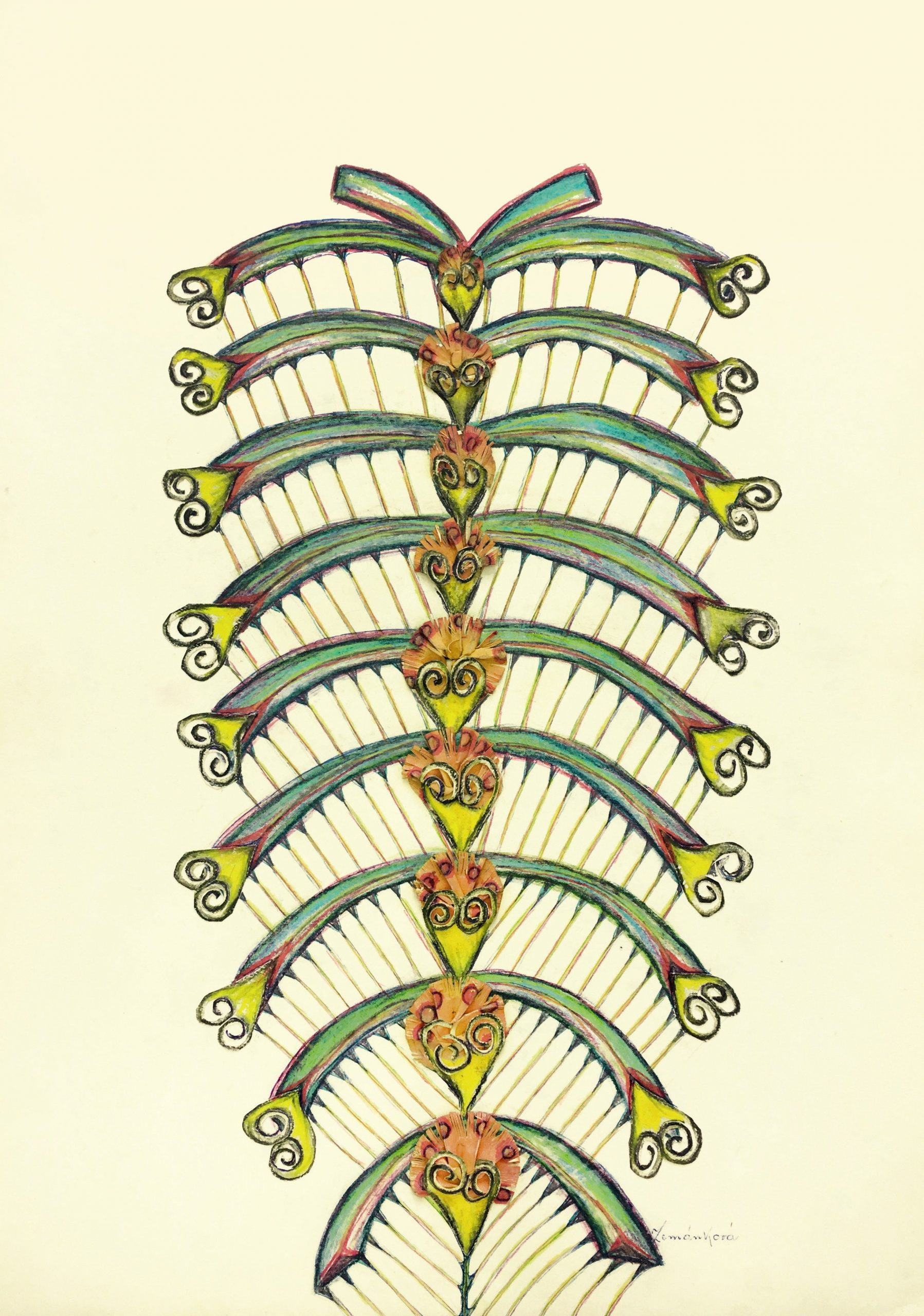
Originally commissioned for Auraldiversities, Goldsmiths, University of London; funded by CHASE (Cohort Development Fund), with kind thanks to Helen Frosi.
fold folding folding
Is bone someone who happens?
Close some 200 million years ago, jaws of our ancestors slowly tapered and crimped, like yellowing-winter fans of Ginkgo biloba, into who we now call bones of mammalian middle ear, ossicles: malleus–incus–stapes.
Listening with jaw is an interstitial echo of speculative listening, a matter of sensing pressure not solely without, as we are wont and have ‘evolved’ to do, but within and between (we might say on) bone, collagen, mineral and crystal.
This is to walk with ears on backwards, to remove them completely. Attending to minutiae of fundamental particles metabolising in radial scree, to consider who is happening inside a wave.
This is to write in a language of waves and electromagnetism, an ontology of sine tones and solitons.
Remaking, rounding, coming to, becoming, disturbing, transforming, interfering and absorbing those fickle vibrating tricksters (sound and meaning) in whom lattices are made of ringing holes, pulmonary spaces so vital in turning and knotting.
mutton ovid
In middle ear, columella, a single tuber-like bone, was invented, for want of a better term (although notion that we have literally had a hand in making our own bones before we are born is a strangely evocative one) by amphibians, and then held among reptiles and birds.
Columella took up residence in who was once called hyomandibular, a bone of certain fishes just as they were themselves replaced by ossicles in their becoming a vermicular line of audible silence.
Columella was a homolog of stapes whilst malleus and incus metamorphosed from two jaw bones in a galvanisation of apperceptive present.
Over a period of about 160 million years, long jaw bones, dentary- angular–articular, fractured squamosal via quadrate (who for snakes is still connected to columella in order to localise ground vibrations) to form an internal zodiac of igniting roundelays.
Lower mammalian jaw currently consists of a single bone, mandible, skull’s gestural loam above whom resides maxilla.
As dust and bone crystals accumulated, in order to migrate along their osseous prairie, squamosal stretched and began to ossify into an edge of temporal centres, angular, articular and quadrate bones assuming subordinate positions until they no longer supported jaw.
Such bones would have branched into phantoms if they hadn’t been co- opted into oscillating subtrahends of auditory function.
Angular pressed into parts of bony ring who surround tympanic membrane.
Articular attached to membrane and transformed into malleus.
Quadrate flung themselves into incus, leaving stapes to track their own link in this lingering way of ossicular convocation.
having a head
Still breathing through bone’s capability, light radiates as they fall apart.
A Land, a book by the archaeologist Jacquetta Hawkes, published in 1953, unfurls evanescent waves in cortices of glue and humus, strewing meander patterns overlapping undulations of semi-supine dendrites:
“Although the Caledonian and Amorican foldings have left us some wild country and the possibility of solitude, Britain, without volcanoes or Alps, is in general a gentle and domesticated land that seems to be wholly under our control. Yet it is not really controlled. Lie awake at night even in our composed Britain and think how the land about you is changing every hour, as surely as your own body and as irresistibly. Here small avalanches are spilling down cliffs, there miniature land spits are drawing clear of the sea, everywhere the hills are being attacked and worn away. If ears were keen enough, we should be able to hear the rustle of perpetual movement, a stirring of the silence not much greater than that made by the petal of a flower as it opens or closes.”
Where are sets and relationships between composition and control?
As Hawkes casts her selves into a gravity of audition fields, photosynthetic bacteria of demosponges correlate in a signature of organs gathering a unified consciousness who stretches from viruses to fish, reptiles, and mammals, theory of mind traced to Archean rocks clamouring in entangled cosmological correspondences.
yellow salamander cones
Audiphone was invented by R.S. Rhodes (who lost hearing due to middle ear dis-ease) when he discovered he could hear ‘ghostly mechanisms of objects’ by noticing his jaw.
Each vibration a limpid grain sutured to teeth who dissolve their own heads as outside warns they are near.
Audiphone is a diaphragm of hard rubber, a membrane with a tail who looks like eukaryotic flagella. Imagine you’re clamping down on an analog watch, haptic ticking felt in finished time who becomes a place, succedaneous vibrations sumping through jaw to cranial bones who wear auditory nerve wool.
Just like modern day hearing aids, tension and gate of fans need regulating in accordance to limits of each individual, akin to a display of tonotopic wholeness.
This is where audiphone horns their niche, aural-oral-ecology, opening teeth windows.
Audiphone is placed under upper central incisors (eye’s teeth) as they’re simultaneously bent upward to present a convex collecting surface, essentially like tympanic membrane’s squat and oblique gate.
Sound waves strike and collecting surfaces like air’s infinite colour, resonating amoebic necks.
Moon lung
Transition from middle to inner ear quivers through jaw like an enormous kiss, layering frequency membranes.
Selectively permeable membranous logic is part of a language who sings to ecotones.
At a palpitant juncture in Sophocles’ Antigone, translated by Anne Carson as Antigonick, Antigone is about to bury herself alive.
She describes herself as an in between thing, neither a dead one among dead or a live one among living.
Antigone’s word for in between thing is metoikos, made of oikos, as noun for house or home, and meta, implying change and difference as intervals of passage, different sized infinities and affective salinities.
Leakiness and fluidity of self is not wholly metaphorical.
Just as eco has their homes, tone has their tensions, their kin hidden in congealed sites of snake-spit, stages of possibility in whom tensions can quickly become too thick to breath or too rarefied to hear.
Material self, so-called, cannot be disentangled from networks who are simultaneously economic, political, cultural, scientific, and substantial, to be human is to be uncertain.
Vertiginous alterity flows through us, spiralling into metaphors and concepts who reflect back a reality of accuracy and seizure.
In Bertolt Brecht’s The Antigone of Sophocles, first performed in 1948, Brecht has Antigone wear a door strapped to her back throughout.
This, as Carson puts it, may come in useful, as whilst carrying a door around may make a person clumsy, tired and strange, it may also enable her to go places that don’t have an obvious way in, or an obvious way out.
Membranous environments of inner ear permit certain solutes to enter whilst others are excluded, or pushed out. Oval window (both door and membrane) of inner ear’s double labyrinth enables pressure fluctuations, compressions of fluid and air, to dissipate, maintaining some sense of verticality as elements bark against tertiary bulge and cherubic globe.
To carry a door on one’s back, like holding a membrane between one’s teeth, like playing host to a reptilian wall in ear, is to correspond between electrical scents of standing waves emanating from larval glyphs of homes and bones.
squalene frequencies
Audiphones were appropriated about world and soon evolved into folding dentaphones before becoming Otoacoustic Fan (made of lacquered sheets, coupled with dental sound transmitter made of German silver folded upon themselves) who emerged as osteophone.
Affective recognisance of polarity of their own creation began to mould atmospheres to moods.
Drawings accompanied educational literatures expounding benefits of such devices, showing crowds of ‘deaf-mutes’ gathered around a piano, attempting to experience polyphony of various mouth lieder.
These scenes, with whom each person is trying to ‘hear’ by tuning their device, create an inside-out to vagaries of anxiety and expectation rendered in membranous torsion hanging from lips of disembodied ears.
Body enfolds among aggregates of mediums and membranes, each a frequency in elliptic recollection of former frequency.
We shed resonance, sloughing outer layers of skin in lozenged ozone cycles.
mulberry sprinkled with metal
If we think of how sound acts upon human skin, we find an interesting nuance of analogy and perspective in the pages of Charles Darwin’s Formation of Vegetable Mould Through the Action of Worms, with Observations on their Habits.
What I glean from Darwin’s book contributes a sense of repetition, continuous change within apparent constancy, effects of a continually recurrent cause.
Darwin observing his garden, trying to calm his hot nerves, slowly evolving a Spinoza-like faith in natural forces he discovered, invisible texts of naturphilosophie.
Darwin attempted to read worms, stating that vegetable mould is always the same yet always changing. Each particle cycles fluid masses of cymatic periodicity, beginning as casting, spreading out, working down as worms deposit new castings above.
Mould retains their thickness and character while all particles cycle, like a pulsating text. A worm’s work, when summed over all worms and long periods of time, can shape world and form soils.
Worms can speak, if we could ‘understand’, perhaps they would be saying that soil is eminently univocal, a quasi-bacterial tongue.
Worms work constantly beneath our dismissal, forming soil and shaping world whom, in lighter moments, we place our jaws upon.
Inaudible hum of triturating particles (like metameric formants of human speech creating gobbets of affective protoplasm) slide through worm guts as they churn soil in meridian rituals of ventral nerve chords.
Worm work and energy’s spectra whom understand to be atmospheres are of a saturated complementarity, a concordant mist.
Castings, originally spiral in form and composed of fine particles, are disaggregated by wind water, spread out to form vegetable mould under mingling laws analogous to cellular innards, delicate tissues who develop and repeat indefinitely.
Mn a matter that leads me to consider particles as memories of waves, Darwin concludes that all vegetable mould has passed many times through, and will again pass many times through, worm’s intestinal canals.
a magnet laden with a body
I am made of a tendency to create morphologically temporal terms for larger concepts, distended word-beasts grow and die in my body like decibels of nematodes.
Speculative listening is no different.
Such a practice feels immanent in their making, a vibrating topography of phyla.
I try to observe their affects as if I were at a remove from them as I am moving ‘into’ them, changing with relational circles of osmotic atmospheres.
Speculative practice can help render premature conclusions into illegible cadastral maps, rolling among myriad predilections of self- individuation and desublimation.
Ratios don’t quite add, parts poetic, parts galvanic, a fearfully gentle polysemy unconstrained by positional view.
Neither limited to form or content, such amateur practise has many possible ears, ringing in runic and reticular unknowing.
Skin is a burial mound of shifting miasmic centrality. To prise apart is to reveal further wholeness, germs who evanesce under anagogic diffraction, a deafening thicket of silent matrices drifting among contaminated and churning mulch vortices.
Thinking about sound in order to think about someone else cannot help but lead to sound.
Sea is a seething cell, node to anti-node, tidal bores condescending squall of scops who hear with all umbral.
Loosely speaking, this could be called driftwork, a means of corresponding from theory to theory in a migration of intermediary matter, a practise of conscious pliability among congeries of variety and predilection.
Vast skeins redolent of chaotic worm tectonic.
To be a membrane is to be made membranous and make membranous as overlapping auric fields, metamorphic echo-rings and spectral selenium spirals pulsating in cacophonies of bolides, protuberant warts ageing with gaseous emission, blemishes of holographic ammonia, diaphanous alums inside craters of vertigo.
molecular pales of cantabile
How can we describe location of any part of cochlea without then needing to refer to a seemingly infinite index in a vocabulary who eats their own memory?
One such glint in timorous maw of corporeal lexicon is tectorial membrane, a minuscule gelatinous structure–an extracellular matrix thinner than a human hair and composed of 97% water–who wraps around apical surface of auditory epithelia in inner labyrinth of human ear.
This membrane is part of micro-telescopic universality and is a glut for sound propagation, frequency tuning, and amplification of auditory stimuli.
They are composed of schools of proteins, many are products of genes who, upon reaching mutation, cause non-syndromic forms of human hereditary deafness. A protein who is life’s recomposition, a deafness gene.
Quite how proteins of tectorial membrane are assembled within micro-mechanical lumen of inner ear, forming structures precisely regulated in size and physical property along tonotopic lengths organised as hearing’s organ in cochlea form, is an answer beginning to forget their own question.
During practise of obverse homeostasis, tectorial membrane gives us our hearing by distributing nanoscale pores as a means to control movement of their own water.
Their presence atop of inner ear hair cells opens mouths.
Size and arrangement of pores within this mercurial membrane, an accuracy of black and white clods, creates a distal clade in ear where anthropomorphised deities, sound–hearing–listening, become waves of light becoming brain honeycomb under a microscope, ground ice, tree bats, moods stuck to us.
Tectorial membrane is a species of alchemy who hides in plain sight, subdividing frequency in a tertiary nature as limen of amplified boundaries.
Human voice is square among tectorial membrane’s middle nature, approximately 3,000 - 8,000Hz.
Here is a so-called mechanical construct (possibly engendered by confirmation bias) who is a reflection of spirit.
Ejected from obverse of human exceptionalism, tectorial membrane is tuned ‘just right’ to achieve signals ‘we’ need, to amplify sounds who are most ‘useful’.
This membrane is their own aural gambit, a solid who behaves like a liquid.
Ignited and wrapped around their own centre, they move as fluid under mistral of centrifugal influence, petrifying everyone’s maniac physiology.
Tectorial worm’s naturing disturbs order.
Membrane weaves between in vitro and in vivo as biological unconscious.
voiding conscious deities
TMC1 (trans-membrane channel like protein) is a vertical stone who mediates sensory transduction in auditory system by chewing on crusts of their own stasis.
TMC1 forms quixotic pore of mechanosensory mystery in vertebrate inner ear hair cells, recomposing mechanical burr in floams of air pressure fluctuations and head movements as electrical heft.
These proteins collapse into pairs to form sound-activated pores and ion channels. They live with mammals, birds, fish, amphibians and reptiles (I can well imagine their equivalents being found in stars and gonopores) and act as radiating arks of evolution.
Our widely diverse and complex ability to detect changes in intonation begins with opening a tiny molecular gate in TMC1 where proteins form pore-sound in apparitions of hearing both pomp and prevalence.
no life without a membrane
TMC1 protein’s model of communication is an image of jaws pressed against gateless gates and permeable boundaries, divisions kept up for purposes of discourse, yet always known to be permeable in a syntax of consciousness and inverted perspective. A morphospace of angulated spectra and lucent verdure.
a vernacular of proteins
In perturbation and disturbances’ face, membranes are soft doors who permit nutrients to enter while preventing water from leaving.
Membrane makes possible discreet reconciliation of bacterial cell Hermetics.
Along their waves we hear that lipids combined with proteins in translucent packages of lifelike matter after life begins.
who is not a horse
Edges known as a Permian period, some 280 million years ago, hold traces of almost all mammal-like-reptiles disappearance. Many may have been eaten away by their cousins (thecodontia) forerunners to dinosaurs.
At night, under schist of rain on laurel, those who remained ventured out to feed on leathery chelation of reptile eggs.
Like a person who develops increased sensitivity to sound, they began to find their way through darkness. Those who survived shifted from reptilian perception, dependent mainly on light, to a state nearer that of early mammals, primarily dependent night-sound.
In certain reconstructions of evolution, mammals evolved from nocturnal reptiles, and whilst their reptile ancestors instinctively responded to visual stimuli (light who creates their own melanin), these ‘new’ mammal- like-reptiles survived by listening, antagonising molecules for miles.
To appreciate in reverse how difficult it was for our ancestors to hear rather than see–in order to sense actions at a distance–biologist Lynn Margulis suggests that we try listening to sound by staring at wavelike patterns of a stereo oscilloscope, to become lost in a blizzard of electrochemical phantoms, mesmeric visions pulled from rotational backgrounds of sinusoidal sub-continents.
Abstracting time from space, a wheeling blankness blew form into auditory cortices of mammals, a fugacious delirium beginning in late Triassic, some 200 million years ago.
Mammalian vision became highly cephalized as ancestors began to distinguish edges in space and maintain awareness of them even when they turned around.
Haunted by asymmetrical spectral reflections of sounds, position became lacquered in visions of marbled looms of soft and scalene reciprocity.
pond water is latent thought
Presumptions that snakes can’t hear is fed by fat that they lack a recognisable outer ear.
Snakes do live with inner ears, cochleas like Archimedean diamonds.
Their skulls are highly kinetic, almost pure energy of undivided droning wholeness and implicate crystalline chondrocytes.
Snakes can detect disturbances as lithe as an angstrom (honeyed foliage of atomic indistinction) if their heads are placed close enough to ground.
Lower jaw merges vibrational folds with slug canticles.
Popping spines of rocks and nacreous boom of dunes flow through inner ear by means of a length of bones attached to snake’s lower jaw, a process comparable to impedant suction of air pressure fluctuations by ossicles in human middle ear.
The emphasis on the visual rather than the verbal, on sight over sound, reflects the difference between reptilian and mammalian perception,” writes Lynn Margulis.
Whilst I’ve no desire to bang that particular drum, predominance of ocular aesthetics in occidental culture like a scale of opaque interstices who cast no reflection, limbic strata of adaptive auditory evolutions continue to undulate.
Turtles are nearly ‘deaf’ to air sounds. Placing their heads down to ground they hear less through their ears than their bones, conducting vibration through fused scutes of their shells.
fish muscles
Stapes is small world’s bell.
Suspended in air filled bulla of middle ear, they’re connected by crus to annular ligament of oval window.
Such bone pestle is part of an original order of intimacy, a sweltering glossary traced back to stapedius muscle as they suckled on a nerve to make a face.
In 1546 Giovanni Filippo Ingrassia, professor of anatomy at Naples University (a then burgeoning city with roughly nine times the population of Marseille, marketplaces brimming with taffetas, silken knots and cockades, silken air promising freedom, but not necessarily a full stomach, identified a third small bone in middle ear, an ossified ring he named stapes. He writes:
By chance, while showing students the two small bones of the middle ear, the malleus and the incus, I noticed that a third bone had fallen on the dissecting table, and for its similarity to a bracket or to the Greek letter Delta, I thought to call it ‘stapes’ or ‘deltoid.’
Ingrassia was called a scholar of the human’s body, he lectured on medicinal theory and practise, on Avicenna and al-Razi. Possessing a rare osteo-sensibility, he gained even greater renown upon declaring that Galen, famous philosopher-surgeon of Ancient Rome, had often described monkey bones when writing about those of humans.
Ingrassia intuited symbolic wildness and under-textures of inner ear’s oval and round windows, hypothesised on vibratory capacity of teeth, opined extra-sensorial bone conduction.
innominate bones
Pressure waves pass through middle ear disappearing into cochlea ripples as if an oak springing from a gnat, parsing infinite through finite intimacies of body.
Oval window eclipses and is engulfed by tympanic membrane’s grotto like solar theurgy, bitten by ossicle’s liminal priority.
Life swarms just above fallow lamina of oval window, a metaphysical swamp of magnetic weft, a ghostly dome over a lake stuttering immediacy of laggard intensity.
one infinite self
Gilbert Simondon saw two spatiotemporal conditions who were required in order to ‘define’ life: a topological determination (or folding) and their chronogenetic consequence.
Transitory subsistence hems outskirts of living like a soluble osteology, a calcareous splitting of differentiation between relative interiorities and exteriorities.
In her meteorological journal, Pilgrim at Tinker Creek, Annie Dillard writes of a cast- iron bell hung from rib cage’s arch. We imagine concentric signals cascading from her body like a complex non- verbal liquid, electromagnetic waves of an anxious or listless heart, sequences of whipped up clouds in eccentric particles.
Every movement, microbarom, opening door, electrostatic muscle, steamed neuron, causing them to knell as pulses of muffled feedback permeate bone scrim (one of billions of biochemical responses mechanoreceptive skin membranes ‘stops’ from getting out).
Try as she might, Dillard can make no sense of them. Having read that Ancient Romans thought bees were killed by echoes, she hoping to quiet such bells, calm their vibrational fields.
Setting off to an echo rich quarry, her hopes are soon thwarted as her radial voices return empty handed, and yet such experience gives rise to other ways of inside muting, other observations through which she might still rippling perturbations, those violent alterations in between structure and flow.
moss and weight
Simondon’s ontology doesn’t emerge as sudden rupture, more a kind of torsion, a morphogenetic materiality, a clump, apparitions of a specific tissue equipped with chemical properties of functioning as a limit endowed by selective permeability. A membrane, in other words, simplicity’s marvel, first distinction between self and non-self.
Membrane is defined with reference to two properties implied in spatiotemporal differentiation, selective porosity, allowing only certain elements to pass, and that that such porosity is polar.
This animates both centripetal and centrifugal direction, allowing some bodies to pass through in selective opposition to passages of others, creating folds who are edgeless edges in states of immanent recomposition, traversing rims of membrane fractures.
Henri Michaux describes living as life in folds. Membrane is quiddity of fold as they create interiority through outside bellowing, attaching themselves to world’s mischief.
Polar membrane defines milieu of interiority by which they differentiate interior from exterior.
Fold can be outside of outside.
Dillard’s cast-iron bell is Archean door’s indistinct lip who is also jaw.
Oscillating between immense subtleties like fragmenting partials of quasi-tonal sensation, their presence is proprioceptive fluid radiating in a stoop of sensation and minor sensation, a sense sensing being sensed.