
Graticules

I can’t tell trees and vertigo apart
I think I am definitely the most arboreal science fiction writer. It’s all right for the rest of you who climbed down, and developed opposable thumbs, and erect posture, and all that. There’s a few of us still up here swinging - Ursula K. Le Guin – The Word of Unbinding
Shakes are cracks in timber, growth-waves after a tree has been felled, mottled rattle in whom imaginations of graticular lines decorticate like involucral bracts of rue
A felled tree (belimbed site synonymous with vertiginous orientation as cosmological extant) if not already transformed, circles their own departure in slow decimal sump
Fallen tree shakes as metabolic ton to environment who alters their selves.
Rather than remaining suspended by centrality, mass sheds kin by oscillating wildly, like Hannah Cohoon’s blazing trees, painted during spiritual visitations like a braille of hummingbirds
ring shake
tree with no mouth converses with vacuum
Growth rings are transient arboreal subsistence, lumpen routes of wandering hearts, concordant alchemy woven through concentric eclogues
Realising that seasonal rates of growth were reflected in tree rings, Anton van Leeuwenhoek calls for fish scales, placing them under microscope’s soft sun, arching up to bellow that lamellae of every ring is a folded almanac of saturnine proportion
A more or less rounded body, sometimes spherical, sometimes flattened, in whom calcareous matter lies down in concentric zones, denser and clearer layers alternate with one another
This description of fish-ear-bone could well be coaxial growth rings.
Piscine ear stones are rings we cannot hear ringing. Found in pelting galls of tangled light, they are animal fossils before they die
Hoping to become velocity of vibration fanning out along three tree axes (among inner bark, across and along rings), John Tyndal wraps his auscultating body around a forest, concluding that aspen and beech are most involved in sonorous transmissions
Tree’s energetic organs are fecund vascular bundles in mouths of lozenged beasts.
Orchards live in heat of their spinning cells facing osmotic north
We break frequencies open, orange wolf-weave of a spider’s spinneret, in gnosis of spectral intimacy
heart shake
tree opens under lunar voltage’s weight
Heartwood is a frozen accident
As wood hardens a tree is thought to die, and yet they can thrive as their organs decay
This seeming contradiction of axes is a vertigo tree of centripetal senescence, an inner transpiration stream along whom volume and vapour of sapwood can incipiently push inert xylem toward invisible mud’s petrified chaos
Cavitation (insane cataract of internal storms) occurs in tree xylem when teeth of water chew holes in atmospheric pressure.
As sap vaporises like Ophelial cells consuming their own organs, kinetic bundles of xylem (who under a microscope look like the spiralling colons of dog fish) thump against revolving layers
A noiseless flowing river, cavitation grows arms of lacerated spermatophores.
Pulse, not unlike a death watch beetle, swallows infrasound of their mating call until they burst
frost shake
moisture’s outside is absorbed by tree as their wounds lap
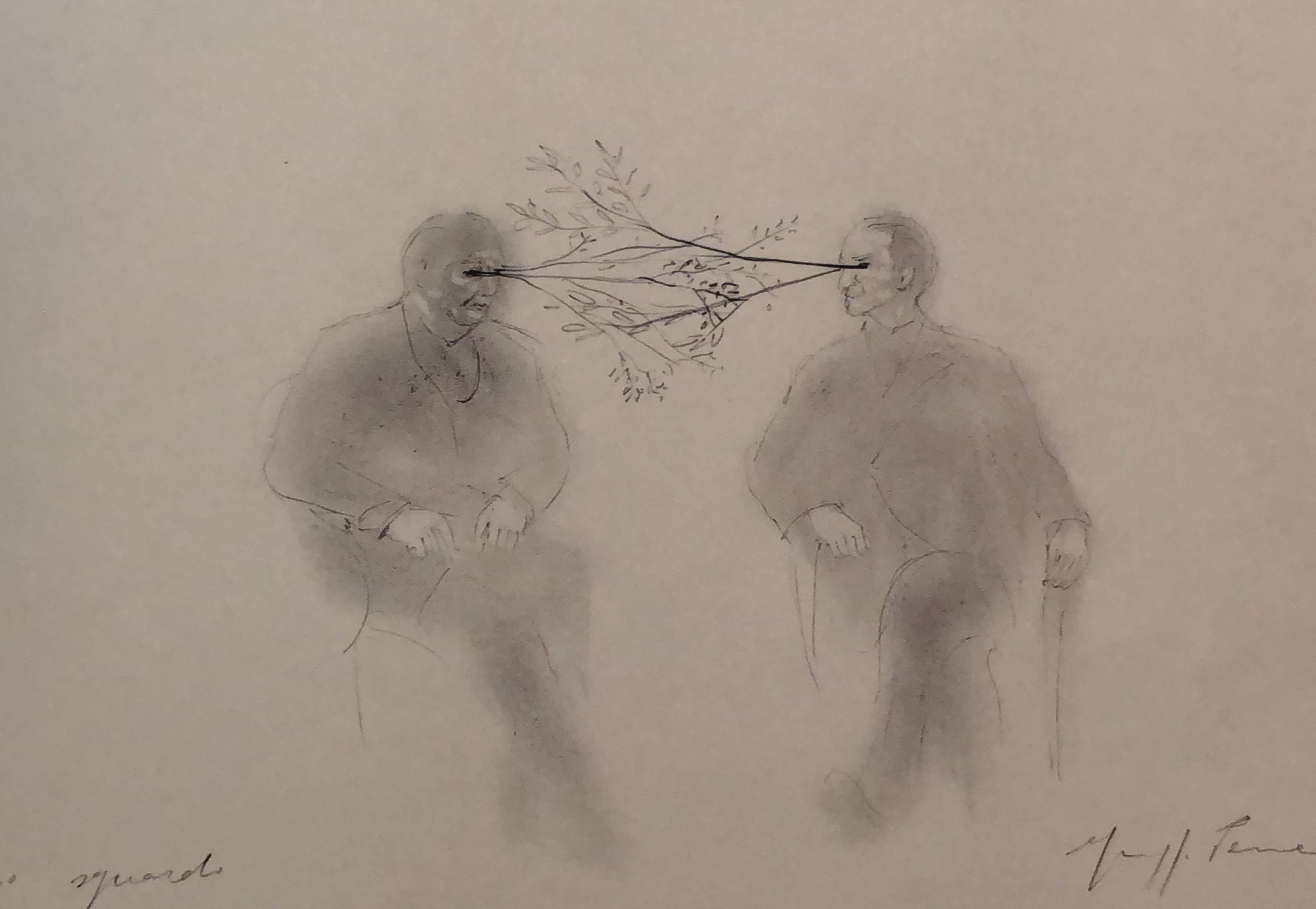
Empedocles believes Aphrodite lit a fire in his eyes, sonorous beams of yellowing extramission
Eyes are a hidden throat
Reticular echolocating clicks penumbral shapes as a bat remakes sound
Duramen, translated to the great hardener, is a word thought to have been coined by Lucretius in book 6 of his On The Nature of Things.
This is his last book and is at pains to explain Epicurean (that gardener of gravity) flecks of geology, meteorology and metempsychosis
Many passages are concerned with portentous natures of thunder, volcanoes and earthquakes, with Lucretius tasking himself to wash such signs from the residual sweat of gods, previously divined in seed patterns of pomegranate and fig
In book 6, Lucretius refers to ice as that obstacle everywhere curbing back eager rivers. Latin aestus can mean both vertigo and emission.
Lucretius’s organs discern meteorological miasma suckling sky and soil in becoming worlds they simultaneously observe, nebulae of vacillating declension in ice who reflects stars.
Sun is an incandescent stone, says Anaxagoras, who lives with time magic of infinite beauty and undulating cosmos
thunder shake
fossilised fields of tree fall above ground
We turn shaking to spinning, a shift mouthed in alterations as air to fluid innervating ear
Such change encases nerve cells within particles of oxygen, microbial richness passing through round window of inner ear’s membranous labyrinth like fulvous nerve-nets
In Zoonomia, Erasmus Darwin writes of a conversation with a famous canal builder called James Brindley, who says that he often observes people reclining over large corn-mill stones, and that by gradually letting stone whirl, they fall asleep
Erasmus subsequently coins rotation therapy, and in his second volume describes a desire to spin others into states of nausea and vim:
...The usual way of reciprocating swinging, like the oscillations of a pendulum, produces a degree of vertigo in those who are unused to it; but to give it greater effect, the patient should be placed in a chair suspended from the ceiling by two parallel cords in contact with each other, the chair should then be forcibly revolved 20 or 40 times one way, and suffered to return spontaneously; which induces a degree of sickness in most adult people, and is well worth an exact and pertinacious trial, for an hour or two, three or four times a day for a month
In 1786 Marcus Herz writes to Immanuel Kant, wondering if vertigo is perhaps the opposite of boredom...
or could it be a condition of confusion in which mind feels themselves to have too fast a succession of ideas?
As heads rotate, effluence becomes meteorological depth, disturbing superficial boundaries of above and below, gyrating in a rain of meted particles
In Religion of Wood, Thomas Merton writes that Shaker chair’s peculiar grace is because they are made by someone capable of believing that an angel might come and sit on them
I can’t help but wonder if semicircular canals, convulsive balance organs of inner ear, are chairs made for gravity
Jan Evangelista Purkinjě holds that visual vertigo is a consequence of conflict between unconscious involuntary muscular actions and voluntary conscious ones in their opposite direction
In order to prove his hypothesis he spins through bodily planes for an hour until electrons in his eyes begin to consume their own muscles
This idea is subsequently taken up by many a clinician as they subject harnessed patients to inured streams of pummelling syncope and pulmonary rotation
Homoeomerous bodies of gravity seeks their lost etiology
Sat on semicircular canal chairs are winds of their own peculiar grace
If creaking and calked chair breaks, gravity becomes their own vertigo, reduced to shaking rings like cumulus piles drifting over plant-held waters
A Shaker rises from their rocking chair, spins air like space of half an hour’s time, branches out to a nearby pond to spin once more, like a top, then blissfully returns to their chair.
Shakers spin to simplicity’s spirit, creating psychological mediums in whom frictionless cooperation reaches maximum possibility
star shake
tree chants static gut flowers
Starshake is finitude in finity trying to take place before centre
Bhagavad Gita’s upside down tree has been called an ontic terror, a symbol who moves cosmos like unravelling worms in astral phonations of entoptic bodies
Centripetal forces of deep love travel along medullary rays unravelling edges of masks who carry luminescence within their soft bones
Motion feels themselves in lives of celestial bodies
Paracelsus states that every physician should simultaneously be an alchemist and an astrologer. Henry Corbin lives this through Mazdean imago terrae, a cosmological botany in which ancient Persian arts of flowers are prima materia (oily water from whom branches infinitely multiply), alchemical meditation acting as a caution against burning flowers
Botanical contemplation provides emblems for imagination flowing through celestial earth, a vernacular of Parsee angels resonating in accord with their plants like bees
In hierophantic space time is no longer profane time where dates can be recorded as history. Time becomes star’s mind as their magnetic fields penetrate into earth.
Terrestrial night closes around them like air around a bird
Liquid circadian fields (eros of hermetic imagination and sensual delight) are enthroned by Charles Fourier as reality principle, one where stars and planets, alive and conscious, correspond with each other and animate cosmos by means of aromal rays
We find bases of Fourier’s laws of passionate attraction (adducing Isaac Newtown’s gravitational calculus) in his early botanical experiments, an intricate and highly personal system in which pots and flowers are carefully arranged by colour, size and need.
Fields of symmetrical patterns emanate and echo throughout his endless visions of social harmony
organ shake
tree is friction, relic, blazon, noise
Anaxagoras is slime on clay, bark, flesh, bone and leaf
He is at a loss to explain why flesh is not to be found in wood, sniffing edges of eldritch orders of intimacy (some self-replicating molecular system enfolding psychoid split before consciousness manipulated with world), a meandering negation of over there when all being were together, when noone was distinct, not even light and dark
He hears in dispersal of seeds what Wilson Bentley tastes in dendritic voltage of snow crystals
During a brief foray into vitreous opacities of entoptic experience, often referred to as light dust, Purkinjě describes seeing black tree-like forms after staring at candle fire close enough to welt, deducing that such branching forms are retina perceiving themselves
Undergoing a similar experiment, J. Eichel observes luminous rings manifesting at periphery of visual field, skin feathers assumed to cycle along his edges as if projections of optic nerve’s compass
After undergoing a number of attempts to manifest rings of light dust, sky no longer seems blue (but so many grades of dissolving violet), as if all that were left of colour were their constellating trajectory, inaudible whistle of acetylene
Entoptic phenomena are a moult of infrasubjective simulacra, lattices of retinal mesh in jellied topologies crackling with meteorological streaks and blue arcs, macular star patterns and umbilical eruptions
Vertigo emerges to loosen mothered membranes of skull, spurting plasmic filaments along subarachnoid vents and infinitesimal electric faces of gravity looking up with stars, convincing us they are silent, that we are down here
covered in static, vertigo returns to their forest